About me
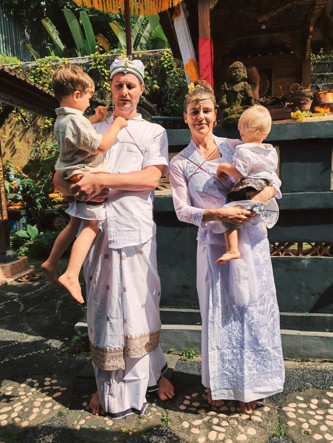
My name is Claudio Fontanive-von Glenck. I was born in Switzerland in 1978 and live with my wife Margarete and our two children in the Toggenburg.
For over twenty years I have practised Buddhist meditation, above all Vipassanā in the tradition of S. N. Goenka and in the Mahāsi tradition. Guided and independent retreats, the study of the early Buddhist discourses and carrying the practice into everyday life form the ground of my path.
Meditation has changed my life fundamentally. What began on the meditation cushion became, over the years, a thorough training of the mind and a wish to pass on what I had received. In 2018 my wife and I founded the Karunahaus in Unterwasser, a seminar and meditation house where people can come to rest, practise, and engage with different paths of inner development.
Since 2009 I have been taught by Ida Sri Bhagawan Ageng Nabe Kanjeng Panembahan Jawi Acarya Daksa Manuaba in the Daya Putih tradition. This Śiva-Buddha path, which comes from Bali and Java, joins meditation with the conscious training of body, energy and everyday action. On 29 December 2025 my wife and I were consecrated by Ida Panembahan Jawi as Mangku, priests of the Śiva-Buddha tradition.
Alongside my spiritual training I completed a training in Essential Psychotherapy in 2024. In my work I bring together meditation, ethical training, self-knowledge and the practical wisdom of Buddhist traditions. What stands at the centre is not belonging to a particular school, but the question of how suffering can be recognised, understood and overcome.
This site
This site is my study desk, open to everyone. It brings together the discourses of the Buddha, a guided way into their central themes, my own study texts on the Abhidhamma, and a cross-traditional Dhamma search.
The Dhamma search opens up 62 text collections from various Buddhist and Indian wisdom traditions. It shows how different schools treat the same basic questions: What causes suffering? What binds the mind? What leads to freedom? Where do the teachings agree, and where do they set different emphases?
Why this site?
The Pāli canon is one of the most significant spiritual traditions of humankind. In the German-speaking world, however, it is hard to reach in a complete and coherent form.
On this site the discourses can be read side by side in German, English and Pāli. They are complemented by thematic entry points, explanations and study materials meant to support the understanding of the texts and their use in one’s own practice.
All content is freely accessible and will remain so. There is no advertising, nothing for sale, and no registration. Anyone who would like to support this work can do so in the form of a voluntary gift, dāna.
Where the texts come from
The translations come from people who devoted a substantial part of their lives to rendering Buddhist texts. Among them are Sabbamittā, Bhikkhu Sujato, Nyanatiloka and Julius Dutoit.
The respective sources, translators and licences are set out in full on the page «Sources & Thanks».
Wherever artificial intelligence is used for translations, comparisons or explanations within the Dhamma search, this is explicitly marked. It serves solely as an aid for opening up the texts. The literal source always comes first.