Satipaṭṭhāna · cetanā
Intention and clear comprehension — satipaṭṭhāna and cetanāHandout for the day of meditation: how intention (cetanā) sets the switch and clear comprehension (sampajañña) makes it visible — with the key passages from DN 22 (Pāli/German), all the exercises of the four satipaṭṭhānas briefly explained, and guidance for practice.
At a glance — 8 chapters
Intention and clear comprehension — Satipaṭṭhāna and Cetanā. Handout for the meditation day · July 2026. Pāli original (DN 22) with the English translation (Bhikkhu Sujato, SuttaCentral — as in this site's library). Placement: canonical quotations are marked as such; the four kinds of clear comprehension come from the commentary to MN 10; the practice sections are application and method, not scripture.
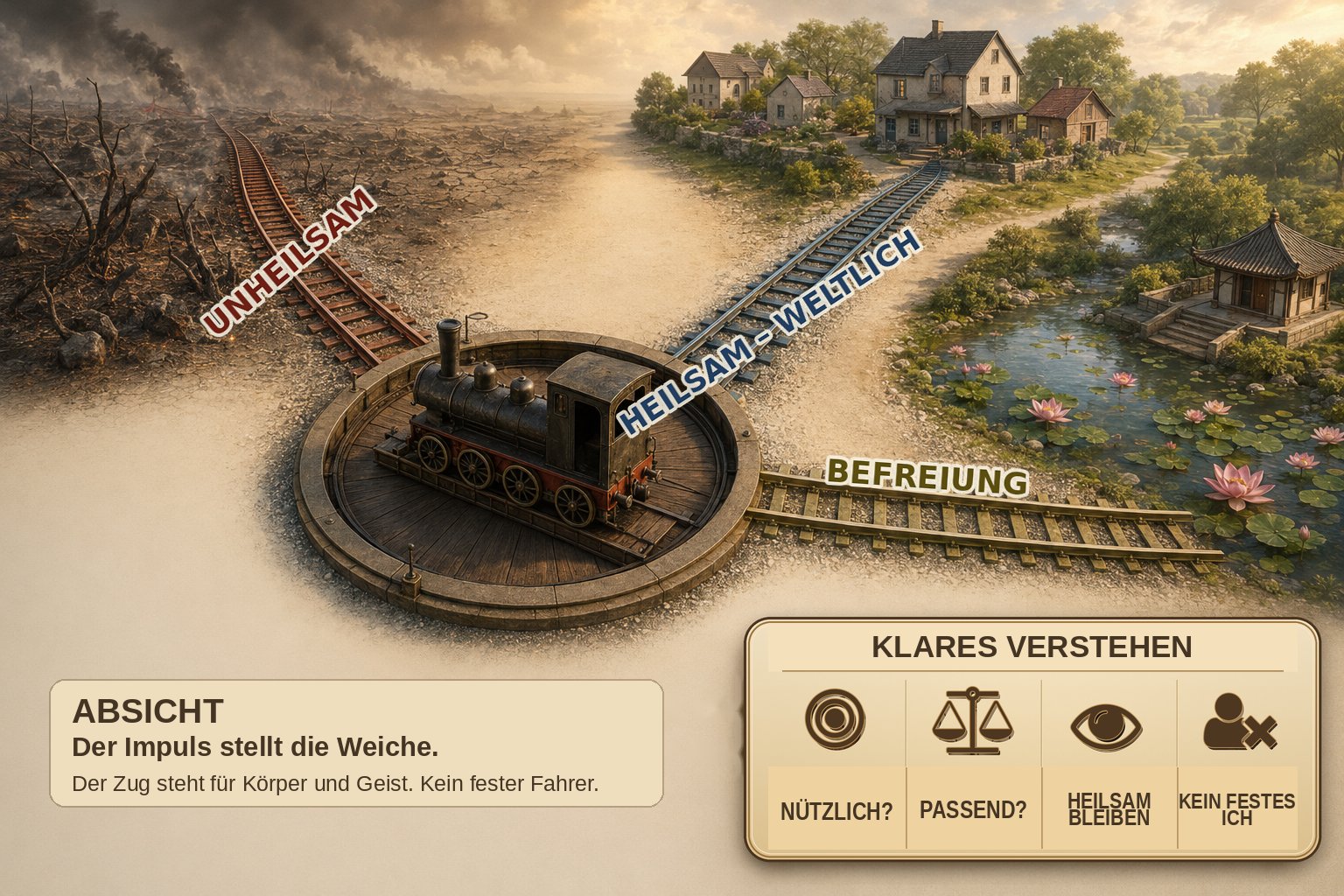
Red: harmful · Blue: wholesome in everyday life · Green-gold: directed towards liberation. The lettering in the picture is German: UNHEILSAM = unwholesome · HEILSAM – WELTLICH = wholesome, worldly · BEFREIUNG = liberation · ABSICHT: „Der Impuls stellt die Weiche" = INTENTION: the impulse sets the points · KLARES VERSTEHEN = clear comprehension, with the four questions NÜTZLICH? (useful?) · PASSEND? (suitable?) · HEILSAM BLEIBEN (stay with the practice) · KEIN FESTES ICH (no fixed self).
How direction arises
The train stands for the ongoing process of body and mind. The turntable is the present moment: here the direction can change.
Intention (cetanā): the first impulse sets the points. Usually it is already there before we consciously decide. Intention is at work in every moment — the train is always moving.
Mindfulness (sati): it notices the impulse and sees where it leads. The impulse is not fixed: it arises, changes and passes away. It does not have to be carried out.
Deed and consequence: the Buddha says: "It is intention that I call deeds." (AN 6.63). That means: it is not the outward action that counts first, but the impulse behind it — the same action can be wholesome or harmful, depending on the intention from which it happens. Kamma is this intentional deed, carried out by body, speech or thought. Its result (vipāka) ripens as experience — pleasant or unpleasant. The result is neither fate nor punishment, and it is not itself a new deed: only how we answer it sets the points again. That is why every moment, even the hardest, holds a new beginning.
Where liberation takes hold: the root of the cycle is ignorance — the not-seeing of what is happening right now. It cannot be taken hold of directly. But intention is the point at which this deep process comes to the surface and becomes experienceable. If the impulse is recognised early, it need not be followed — a harmful movement can end before it becomes words or deeds. Old habits do keep triggering the impulse again and again; that is not failure, but the path of practice itself. Every clearly seen impulse receives less nourishment — and precisely this seeing dissolves ignorance step by step. (AN 6.63; SN 12.38)
The three tracks
Red — harmful (akusala): the impulse comes from greed, aversion or delusion. It harms us and others — in the picture, the burnt landscape. Examples: a word that wants to wound out of anger; envy that begrudges another their happiness; deceiving for one's own advantage. What is decisive is the root, not the outward form: holding on can be wholesome too — to the path of practice — and so can letting go — of what harms. The impulse is harmful when it comes from greed, aversion or delusion.
Blue — wholesome in everyday life (kusala): the impulse comes from generosity, kindness and clarity. It builds up — in the picture, the village: good living together, trust, a quiet conscience. Yet this track too remains within the cycle: it creates good, but not yet freedom.
Green-gold — directed towards liberation: the same wholesome forces, now joined with letting go and clear seeing — in the picture, the still pond with the lotus flowers. This track leads out of the cycle. The Buddha thus distinguishes wholesome action that bears good worldly fruit from the path that leads to liberation (MN 117).
Four clear questions — sampajañña
Sampajañña means clear comprehension: knowing what one is doing and where it leads. The old commentary (to MN 10) names four kinds — put here as questions:
1. Useful? (sātthaka) — does this action really help? Does it lead to clarity and freedom — or does it feed greed, ill will and self-deception?
2. Suitable? (sappāya) — is this the right way now, at the right time and by the right means?
3. Staying with the practice? (gocara) — does mindfulness stay with what is happening, even in the middle of the action? The field of practice is not lost.
4. No fixed self? (asammoha) — is it seen that the whole body-mind process — and within it intention, action and result — arises and passes away again (anicca)? There is no unchanging driver sitting behind it: the train runs, but a fixed engineer is nowhere to be found.
Core: intention sets the points. Clear comprehension recognises the impulse early — it need not be fed or carried out. What is seen in this way loses its compulsion: between impulse and action a space opens, and where there was automatism, choice becomes possible. With every repetition the mind inclines of itself towards the wholesome — not by suppression, but by understanding. The place where this freedom is practised is always the present moment.
The discourse: Mahāsatipaṭṭhāna Sutta (DN 22)
The basis of the day — the key passages in the Pāli original with the translation as it also stands in this site's library.
The opening — the one path and the four fields
«Ekāyano ayaṁ, bhikkhave, maggo sattānaṁ visuddhiyā, sokaparidevānaṁ samatikkamāya dukkhadomanassānaṁ atthaṅgamāya ñāyassa adhigamāya nibbānassa sacchikiriyāya, yadidaṁ cattāro satipaṭṭhānā. Katame cattāro?»
"Mendicants, the four kinds of mindfulness meditation are the path to convergence. They are in order to purify sentient beings, to get past sorrow and crying, to make an end of pain and sadness, to discover the system, and to realize extinguishment. What four?" (DN 22:1.7–8)
«Idha, bhikkhave, bhikkhu kāye kāyānupassī viharati ātāpī sampajāno satimā vineyya loke abhijjhādomanassaṁ, vedanāsu vedanānupassī viharati …, citte cittānupassī viharati …, dhammesu dhammānupassī viharati ātāpī sampajāno satimā vineyya loke abhijjhādomanassaṁ.»
"It's when a mendicant meditates by observing an aspect of the body—keen, aware, and mindful, rid of covetousness and displeasure for the world. They meditate observing an aspect of feelings … an aspect of the mind … an aspect of principles—keen, aware, and mindful, rid of covetousness and displeasure for the world." (DN 22:1.9–12)
Three qualities accompany each of the four foundations: keen (ātāpī), clearly comprehending (sampajāno — here "aware"), mindful (satimā).
The passage on clear comprehension
«Puna caparaṁ, bhikkhave, bhikkhu abhikkante paṭikkante sampajānakārī hoti, ālokite vilokite sampajānakārī hoti, samiñjite pasārite sampajānakārī hoti, saṅghāṭipattacīvaradhāraṇe sampajānakārī hoti, asite pīte khāyite sāyite sampajānakārī hoti, uccārapassāvakamme sampajānakārī hoti, gate ṭhite nisinne sutte jāgarite bhāsite tuṇhībhāve sampajānakārī hoti.»
"Furthermore, a mendicant acts with situational awareness when going out and coming back; when looking ahead and aside; when bending and extending the limbs; when bearing the outer robe, bowl, and robes; when eating, drinking, chewing, and tasting; when urinating and defecating; when walking, standing, sitting, sleeping, waking, speaking, and keeping silent." (DN 22:4.1)
"Situational awareness" is this translation's word for sampajañña — the same clear comprehension as above. And in every "when going out, when bending, when eating …" there is first of all an intention (cetanā): clear comprehension belongs not only on the cushion, but in every ordinary action.
The four satipaṭṭhānas — overview and exercises explained
| Field | Exercises according to DN 22 |
|---|---|
| 1 · Body (kāyānupassanā) | breath · four postures · clear comprehension in all activities · parts of the body · four elements · charnel-ground contemplations |
| 2 · Feelings (vedanānupassanā) | pleasant, painful, neutral — each of them either of the flesh (worldly) or not of the flesh (arising from the practice) |
| 3 · Mind (cittānupassanā) | recognising the state of mind as it is: with/without greed, hatred, delusion · constricted/scattered · expansive/not expansive · concentrated/unconcentrated · liberated/not liberated |
| 4 · Principles (dhammānupassanā) | five hindrances · five aggregates · six sense fields · seven awakening factors · four noble truths |
1 · Body (kāyānupassanā) — six exercises
Breath (ānāpānasati) — knowing that one is breathing in and out; recognising long and short breaths; experiencing the whole body along with it; calming the bodily process. The breath is the anchor in the now — always there, always now.
The four postures (iriyāpatha) — when walking, knowing "I am walking", and likewise when standing, sitting, lying down. Feeling the posture from within, not merely changing it in passing.
Clear comprehension (sampajañña) — knowing in all activities what one is doing (the passage above). Here mindfulness and intention are most closely joined.
Parts of the body (paṭikūlamanasikāra) — seeing the body as a composite: hair, skin, bones, organs … Sober instead of "beautiful" or "ugly" — this dissolves both infatuation with the body and fear for it.
The four elements (dhātumanasikāra) — experiencing the body as nature: solidity (earth), fluidity (water), warmth (fire), movement (wind). Nature, not "I" and "mine".
Charnel-ground contemplations (sivathika) — bringing to mind: this body too is of this nature, will become like this, does not get past it. Impermanence not as an idea, but as a fact.
2 · Feelings (vedanānupassanā)
Every moment has a feeling tone: pleasant, painful or neutral. It is simply recognised: "I feel a pleasant feeling." And with it the second distinction:
Of the flesh (worldly) (sāmisa) — bound to the five senses: the pleasure of good food, the pain in the knee, the annoyance at noise, the agreeable feeling at praise.
Not of the flesh (not worldly) (nirāmisa) — arisen from the practice and the inner path: the quiet joy of concentration, the pain of a still unfulfilled longing for freedom, the equanimity of deep stillness. So meditative experiences too are feelings — and are observed in just the same way.
Why this matters: it is at the feeling that the points are set. Otherwise grasping follows automatically upon the pleasant, and rejection upon the unpleasant. Whoever recognises the feeling tone clearly, before the reaction starts up, has the impulse in view.
3 · Mind (cittānupassanā)
Like a look in the mirror: recognising the present state of mind as it just is — with greed or free of greed, with hatred or free of hatred, deluded or clear; constricted or scattered, expansive or narrow, concentrated or unconcentrated, liberated or not liberated. Nothing is improved and nothing is condemned — only honestly recognised. It is precisely this plain recognising that already changes the state.
4 · Natural principles (dhammānupassanā)
Five hindrances — sensual desire, ill will, dullness, restlessness, doubt: knowing whether they are there or not, how they arise and how they go again.
Five aggregates — experience broken down into its processes: form, feeling, perception, formations, consciousness — each of them arising and passing away. Among the formations stands intention itself (next section).
Six sense fields — eye, ear, nose, tongue, body, mind with their objects: recognising where contact happens and where a fetter arises out of it.
Seven awakening factors — mindfulness, investigation, energy, joy, stillness, concentration, equanimity: recognising which are present and bringing them to unfolding.
Four noble truths — suffering, its origin, its ceasing, the way to it — seen as present reality, not as doctrine.
The refrain — after every single exercise: observe internally and externally. See arising and passing away. Mindfulness only so far as is needed for bare recognition ("the body exists"). Abide independent, grasping at nothing in the world. (DN 22:2.11–13)
What the refrain means: internally and externally — observing the same process in oneself and understanding that it runs in exactly the same way in everyone else: it is nature, nothing personal. Arising and passing away — the theme is not the things themselves but their change; here anicca becomes experience instead of concept. Bare recognition — only as much mindfulness as the knowing needs: "the body exists", without a story, without evaluation, without making an I out of it. Abide independent, grasp nothing — the aim of every single exercise: not to cling even to the observing itself.
The refrain stands in the discourse after each of the exercises — it makes all of them into the same single movement: seeing and letting go. Without it, satipaṭṭhāna would be mere attention technique; with it, it is the path to liberation.
Cetanā and the four fields — the connection
Intention is not a fifth field beside the four — it runs through all four. The Buddha expressly defines the formations (the fourth aggregate) as intention:
«Chayime, bhikkhave, cetanākāyā — rūpasañcetanā, saddasañcetanā, gandhasañcetanā, rasasañcetanā, phoṭṭhabbasañcetanā, dhammasañcetanā.»
"There are these six classes of intention: intention regarding sights, sounds, smells, tastes, touches, and ideas." (SN 22.56)
To every kind of experience — what is seen, heard, thought — the mind answers with an impulse. That is why the turntable is to be found in each of the four fields:
In the body: every movement is preceded by an intention — the intention to stand up, to turn, to open the eyes. In the postures and in clear comprehension precisely this impulse becomes visible: walking meditation is the field of practice in which cetanā is most easily caught.
In the feelings: feeling is the trigger of intention. Upon the pleasant follows the impulse to hold on, upon the unpleasant the impulse to push away. Between feeling and impulse lies the points — and exactly there the contemplation of feeling takes hold. And what we intend again and again gives consciousness a support and carries the cycle onward (SN 12.38).
In the mind: the state of mind is the climate in which intentions arise: in a greedy mind, grasping impulses sprout; in a mind carried by kindness, giving ones. The contemplation of mind shows the weather before the single lightning strikes.
In the principles: here intention itself becomes the object of observation — as a formation among the five aggregates. It is seen as it arises and passes away: a process, no driver. The hindrances show what drives impulses; the awakening factors, what clarifies them.
In one sentence: satipaṭṭhāna is the field of observation, cetanā is what sets the points there — in each of the four fields. Mindfulness sees the impulse, clear comprehension examines it, and at the non-grasping of the refrain its power ends.
How it is practised
In sitting: before every movement an intention is there. When the impulse comes to change posture or to open the eyes: first notice it, then observe what happens to the impulse. Often it passes of itself — and with it the urge.
In walking: before setting off, before turning, before stopping: perceive the brief moment of intention. It is fine, but it can be experienced. Lifting, carrying, placing the foot — each is preceded by an impulse.
In everyday life: while eating, when opening a door, before speaking: pause briefly and put one of the four questions. Useful? Suitable? In this way clear comprehension comes into the most ordinary actions — which is exactly where it belongs (DN 22:4.1).
Suppress nothing: it is not a matter of fighting impulses or condemning oneself. It is a matter of seeing them. What is clearly seen loses its power of itself. Noticing "too late" is practice as well — a next moment is coming.
Core: between impulse and action lies a space. Mindfulness makes it visible, clear comprehension uses it. There, on the turntable of the present moment, the points are set — again and again, anew.
Sources
DN 22 (Mahāsatipaṭṭhāna Sutta) · AN 6.63 (Nibbedhika Sutta) · SN 22.56 · SN 12.38 · SN 12.2 · MN 117 · the four kinds of clear comprehension: commentary to MN 10 (sātthaka-, sappāya-, gocara-, asammoha-sampajañña). Pāli and English translation (Bhikkhu Sujato, SuttaCentral) as in the library of this site — the whole discourse can be read there.
Pāli terms in English
The 27 technical terms of this text, in alphabetical order — linked terms lead to a fuller term page.
- akusala
- unwholesome
- ānāpānasati
- mindfulness of breathing — Mindfulness of the in-breath and out-breath.
- anicca
- impermanence — arising and passing away.
- asammoha-sampajañña
- clear comprehension of non-delusion — The fourth kind: no doer is found, only the process.
- ātāpī
- ardent — with energy (= viriya).
- bhikkhu
- monk
- cetanā
- intention, volition — The intentional moment in every experience. 'It is intention that I call action,' says the Buddha — cetanā ties the analysis of experience to ethics.
- cetanākāyā
- bodies of volition — Six, arranged according to the six sense doors.
- dhammānupassanā
- contemplation of phenomena — The fourth foundation of mindfulness.
- ekāyana
- the one way — The opening word of the Satipaṭṭhāna Sutta — 'the direct path'.
- iriyāpatha
- posture — Walking, standing, sitting, lying down as mindfulness practice.
- kamma
- intention and action — Action as intentional doing (kamma) with consequences: what is done out of greed, hatred or delusion bears different fruit from what is done in their absence. The canon means intention, deed and effect — not a ledger of fate.
- kāyānupassanā
- contemplation of the body — The first foundation of mindfulness.
- kusala
- wholesome — What comes from non-greed, non-hatred and non-delusion and leads to welfare.
- mahāsatipaṭṭhāna-sutta
- Great Discourse on the Foundations of Mindfulness — DN 22 — the extended version, including the four truths.
- nirāmisa
- unworldly — Feeling not bound up with the senses — the joy of absorption, for instance.
- pāli
- the canonical language of Theravāda — Literally 'text, line' — the language of the southern canon.
- sāmisa
- worldly — Feeling bound up with the senses.
- sampajānakārī
- acting with clear comprehension
- sampajañña
- clear comprehension — Clear understanding.
- sappāya
- suitable — What is conducive to practice — place, food, climate, people.
- sati
- mindfulness — presence (a sobhana-cetasika).
- satimā
- mindful — From the standard formula 'ardent, clearly comprehending, mindful'.
- satipaṭṭhāna
- foundations of mindfulness — Foundation(s) of mindfulness (body, feeling, mind, phenomena).
- sātthaka
- purposeful — One of the four kinds of clear comprehension: does it serve a purpose?
- sutta
- discourse
- vipāka
- result — The result of earlier volition — itself not new kamma.